How to Balance Equations in Chemistry?
You can balance a chemical equation by adjusting coefficients so that the number of atoms on both sides becomes equal.
Balancing chemical equations can feel confusing at first. Many students struggle to make both sides equal.
But once you learn a clear method, it becomes simple and logical.
In this guide, you will also see examples, tips, and common mistakes to avoid.
Step-by-Step: How to Balance Equations in Chemistry
Step 1: Write the Unbalanced Equation
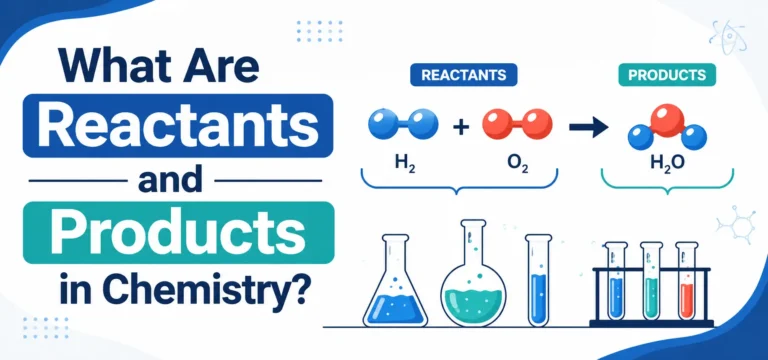
H₂ + O₂ → H₂O
Step 2: Count Atoms
| Element | Left | Right |
|---|---|---|
| H | 2 | 2 |
| O | 2 | 1 |
Step 3: Balance One Element
H₂ + O₂ → 2H₂O
Step 4: Balance Remaining Elements
2H₂ + O₂ → 2H₂O
Step 5: Final Check
| Element | Left | Right |
|---|---|---|
| H | 4 | 4 |
| O | 2 | 2 |
Still finding this difficult? Get simple step-by-step help from a chemistry tutor.
Try It Yourself
Now test your understanding:
1. CH₄ + O₂ → CO₂ + H₂O
2. Na + Cl₂ → NaCl
3. Al + O₂ → Al₂O₃
Pro Tips to Balance Faster
- Use these simple tips:
- Start with metals first
- Leave hydrogen and oxygen till last
- Use the smallest whole numbers
- Always double-check
These tips save time in exams.
Common Mistakes to Avoid
Avoid these errors:
- Changing chemical formulas
- Ignoring atom count
- Not checking the final answer
- Using fractions in the final equation
These mistakes reduce accuracy.
If you keep making these mistakes, 1-1 help can fix them quickly.
Answers to Practice Questions
Check your answers below:
1. CH₄ + 2O₂ → CO₂ + 2H₂O
2. 2Na + Cl₂ → 2NaCl
3. 4Al + 3O₂ → 2Al₂O₃
Conclusion
Learning how to balance equations in chemistry is a key skill. It improves your confidence and exam performance.
Start with simple questions. Practise daily. Stay consistent. You will master it faster than you think.
FAQs
Balancing a chemical equation means making the number of atoms equal on both sides of the equation. This follows the Law of Conservation of Mass.
Coefficients are numbers placed before chemical formulas. They help balance the number of atoms without changing the compound itself.
Example:
2H₂O
An equation is balanced when:
1. Both sides have equal atoms
2. Coefficients are in whole numbers
3. Chemical formulas stay unchanged
Almost all chemical reactions need balancing, including:
1. Combination reactions
2. Decomposition reactions
3. Displacement reactions
4. Combustion reactions
No, you should never change subscripts. Changing them creates a different substance and makes the equation incorrect.