
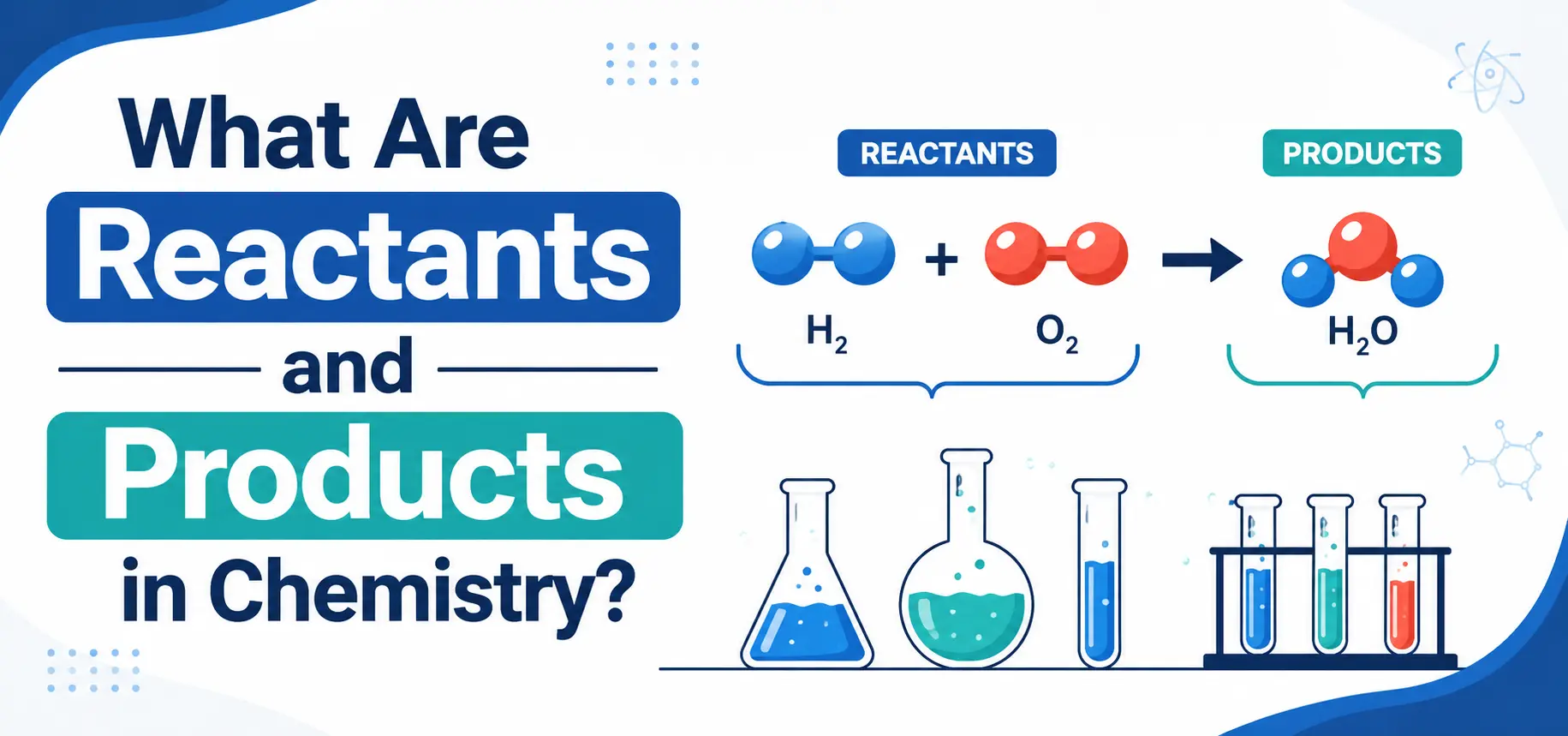
Reactants are substances that take part in a chemical reaction. Products are the new substances formed after the reaction.
What Are Reactants?
Reactants are substances that take part in a chemical reaction. They are the starting materials before the reaction happens.
In chemical equations, reactants appear on the left side of the arrow.
Example of Reactants
In this equation:
- Hydrogen (H₂) is a reactant
- Oxygen (O₂) is a reactant
These substances react together to form water.
What Are Products?
Products are the new substances formed during a chemical reaction. They appear on the right side of a chemical equation.
Products usually have different properties from the reactants.
Example of Products
In this equation:
- Water (H₂O) is the product
Hydrogen and oxygen change into water during the reaction.
Reactants vs Products
| Feature | Reactants | Products |
|---|---|---|
| Position in the equation | Left side | Right side |
| Role | Starting substances | New substances formed |
| During reaction | Used up | Produced |
| Bonds | Break | Form |
How to Identify Reactants and Products in Equations
Students often lose marks because they read equations incorrectly. The arrow shows the direction of the reaction.
Example
Reactants
- Magnesium (Mg)
- Oxygen (O₂)
Product
- Magnesium oxide (MgO)
Easy Rule to Remember Reactants and Products
| Side of the Equation | Meaning |
|---|---|
| Left side | Reactants |
| Right side | Products |
Why Do Reactants Change into Products?
Chemical reactions happen because atoms rearrange.
During reactions:
- old bonds break
- atoms rearrange
- new bonds form
This creates new substances called products.
Common GCSE Exam Questions
1. Identify the Reactants in the Following Equation.
Answer
The reactants are:
- Hydrogen (H₂)
- Oxygen (O₂)
2. Identify the Product in the Following Equation.
Answer
The product is:
- Magnesium oxide (MgO)
3. Explain Why Products Have Different Properties from Reactants.
Products have different structures and bonding arrangements from the reactants.
4. Explain Why Reactants Are Written on the Left Side of a Chemical Equation.
Reactants are the starting substances, so they are written before the reaction arrow.
5. Explain What the Arrow Means in a Chemical Equation.
The arrow means “reacts to form”.
6. Explain Why Reactants Decrease During a Chemical Reaction.
Reactants decrease because they are used to form products during the reaction.
7. Identify the Products Formed During Rusting.
Answer
The product formed is:
- Iron oxide (Fe₂O₃)
8. Explain Why New Products Form During Chemical Reactions.
New products form because atoms rearrange and create new substances during the reaction.
Common A-Level Exam Questions
1. Explain Why Products May Have Different Physical and Chemical Properties from Reactants.
Products have different bonding, structures, and arrangements of atoms compared to the reactants.
2. Explain Why Reactants Must Collide for a Reaction to Occur.
Reactant particles must collide with enough energy to break bonds and form new products.
3. Explain Why Some Reactions Produce More Than One Product.
Different atoms rearrange during reactions, which can form multiple substances.
4. Explain Why Reactants Are Conserved During Chemical Reactions.
The atoms from reactants rearrange into products, but no atoms are created or destroyed.
5. Why Products in Reversible Reactions Can Become Reactants.
In reversible reactions, products can react together to reform the original reactants.
6. Why Bond Breaking and Bond Forming Are Important in Reactions.
Bonds in reactants break, and new bonds form to create products.
7. Why Reactants and Products Must Follow Balanced Equations.
Balanced equations ensure the number of atoms remains equal on both sides of the reaction.
8. Why Some Reactants Are in Excess During Chemical Reactions.
Excess reactants ensure that the other reactant is completely consumed during the reaction.
Read More What Is the Law of Conservation of Mass?
FAQs
What Are Reactants in Chemistry?
Reactants are the starting substances in a chemical reaction. They change during the reaction to form new substances called products.
What Are Products in Chemistry?
Products are the new substances formed after a chemical reaction takes place. They appear on the right side of a chemical equation.
What Is the Difference Between Reactants and Products?
Reactants are substances present before a reaction, while products are the substances formed after the reaction.
How Can You Identify Reactants and Products in an Equation?
Reactants are written on the left side of the arrow, while products are written on the right side.
Example:
What Does the Arrow Mean in a Chemical Equation?
The arrow means “reacts to form” and shows reactants changing into products.
Why Do Reactants Form Products?
Reactants form products because atoms rearrange during chemical reactions and create new substances.
Can Products Become Reactants?
Yes. In reversible reactions, products can react again to form the original reactants.
Why Do Products Have Different Properties from Reactants?
Products have different properties because chemical reactions create new bonding arrangements and structures.
Are Reactants Destroyed During Chemical Reactions?
No. The atoms in reactants rearrange to form products, but atoms are not destroyed.
What Are Examples of Reactants and Products?
In the reaction below:
- Reactants: Magnesium and oxygen
- Product: Magnesium oxide